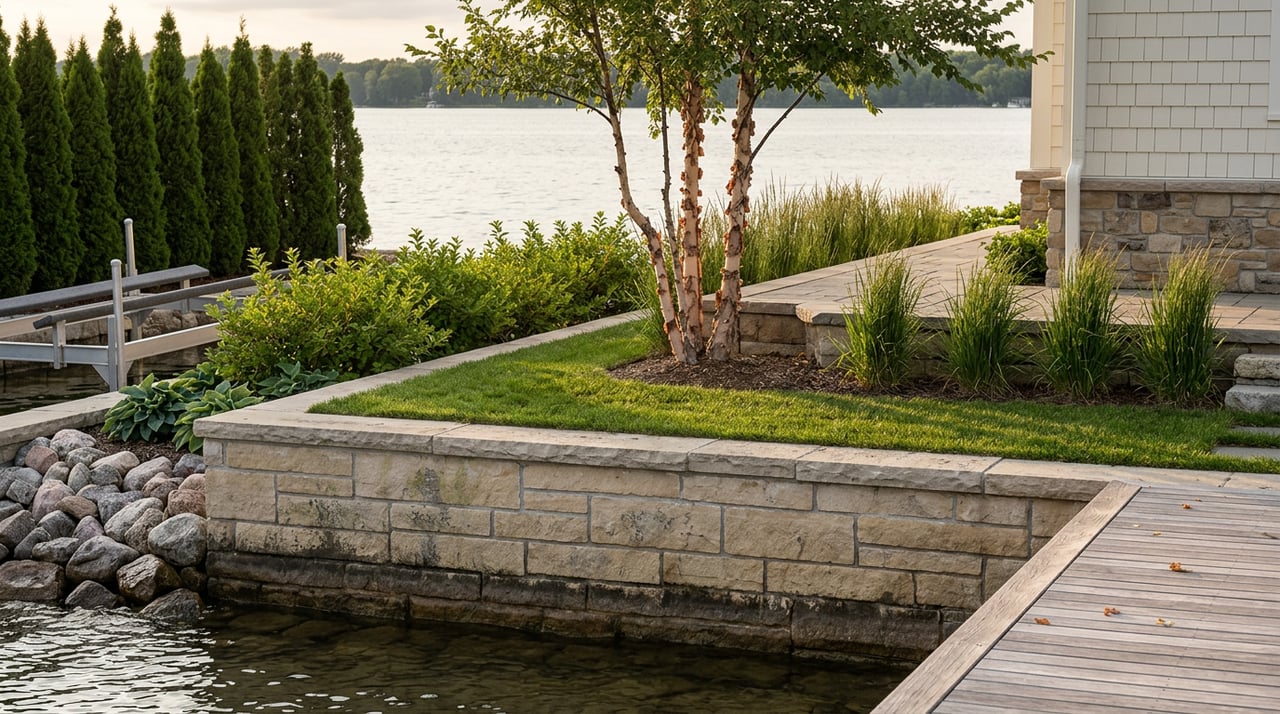
Dan Gustafson is a real estate agent. He also happens to be, by his own account, one of the more knowledgeable people in the state on the subject of riparian rights, the legal term for the privileges that come with land touching a body of water. He learned the subject the hard way. In 2020 he bought a set of water rights on a strip of Orono shoreline, rights that had been separated from the house across the street back in 1984, when the original owners signed a quitclaim deed giving the city a sliver of land but kept the right to install a dock. Gustafson's plan to build one with several boat slips cleared a first round of approval from the Lake Minnetonka Conservation District in 2023. Then a group of current and former city officials pushed back, the approval unraveled, and the fight is still unresolved as of last year, four decades after the rights were first split from the property.
That case is not a one-off curiosity. It is a fair preview of what happens on this lake when a transaction touches the water instead of just the house.
The house is the easy part
Most of what determines how smoothly a Lake Minnetonka closing goes has nothing to do with square footage, roof age, or even price. A 2024 shoreline-city report from the Minneapolis Area REALTORS put median sale prices anywhere from roughly $840,000 in Excelsior to $2.29 million in Minnetonka Beach, with Tonka Bay, Orono, Wayzata, and Deephaven scattered across that range. That spread tells you the lake does not price like one market. It also hides the real variable, which is that two homes at the same price point can come with dramatically different water rights, and the buyer often does not find out which kind they are getting until well into the transaction.
The reason is structural. The Lake Minnetonka Conservation District coordinates dock and shoreline rules across 14 cities and two counties, layered on top of Minnesota DNR shoreland standards and Minnehaha Creek Watershed District oversight of anything that disturbs the shore itself. Add roughly 4,000 residential and commercial properties on the lake's 42 bays, decades of individually negotiated variances, and a grandfather clause that dates back to 1978, and you get a body of water where "the dock comes with the house" is a claim worth verifying rather than assuming.
This has happened before, more than once
Gustafson's case is the most recent, but it is not the first time a Lake Minnetonka dock has ended up in court. In Shorewood, two families bought a small undeveloped lot with deeded lake access and installed a seasonal dock in 2017. The city said it violated code. The dispute worked its way through the district court, an appeal, and eventually landed in front of the Minnesota Supreme Court. Guy Sanschagrin, one of the owners, put it plainly when asked why they kept fighting a case that had already cost the city more than $50,000: "At this point, it's more like the principle of the thing."
A few miles away in Minnetonka Beach, homeowners sued the city and the LMCD over a municipal dock known as City Dock No. 10, arguing that its angle across the water in front of their property blocked them from building a dock of their own. That case ran for years and reached the state Court of Appeals before a partial reversal in 2021.
Three disputes, three different cities, three different legal mechanisms, all inside a five-year window. None of these involved a house that failed inspection. All of them involved a dock, a mooring, or a strip of shoreline whose rights were less settled than the parties assumed when they bought.
What the LMCD actually controls, and why it matters before you write an offer
A few specific rules explain why dock status deserves the same scrutiny as a roof or a foundation.
The 1978 line matters. Any dock or mooring that existed before May 3, 1978 falls under nonconforming-use rules rather than current code, and it needs its own permit to stay that way. If a seller describes a dock as grandfathered, that status should be documented, not assumed.
Watercraft counts are capped by shoreline footage. The LMCD's rule allows one watercraft per 50 feet of continuous shoreline, with sites established before August 30, 1978 capped at two boats and newer sites capped at four, regardless of how many people own the property. A buyer picturing three boats at the dock should confirm the site actually supports that many before closing.
Dimensions are tightly bounded. A dock, deck, or platform can exceed 8 feet in one direction but not both, so an 8-by-12 configuration is fine while a 9-by-12 is not.
Neighboring variances can affect a property you're not buying variances for. The LMCD's own guidance for lakeshore owners notes that a property or its neighbors may have variances that permanently alter the dock use area or the watercraft allowed there, which means a clean-looking listing can still sit inside a shared or contested use area established years earlier.
State approval is not the same as local approval. The DNR has said that a dock no wider than 8 feet, built simply to reach navigable water, will rarely need a state public waters permit. That is a floor, not a finish line. LMCD and municipal ordinances still govern how that same dock can be placed and used, so a seller who says "the DNR never required a permit" has answered only part of the question.
Low water changes the rules mid-season. When the lake falls below 928.0 feet NGVD, the LMCD can declare low water, which allows seasonal docks to extend 30 to 60 feet beyond the normal use area without a separate permit, depending on how low the lake has dropped. That flexibility disappears automatically once the lake holds at 928.6 feet for five straight days. Anyone buying or selling during a low-water stretch should know the dock's current length may not be its normal length.
The clock on a permit or variance runs 60 to 120 days. That is the LMCD's own estimate for a typical application, with minor administrative changes taking 30 to 60 days. A buyer counting on a quick dock modification after closing should build that runway into their plans, not assume it happens over a weekend.
The other document gap: septic
Dock rights get the headlines, but there is a quieter disclosure gap worth flagging for anyone selling an older lake home. Minnesota state law does not require a septic compliance inspection before a property changes hands, according to state Pollution Control Agency guidance, though many county, city, and township ordinances do, particularly in shoreland areas, and lenders frequently require one regardless of local rule. A seller property disclosure describing the system's condition is not a substitute for that inspection. If a home relies on septic rather than municipal sewer, confirming which requirement applies in that specific city, before listing, avoids a late-stage scramble.
What this means before you sign anything
For sellers, the fix is straightforward: gather the dock's permit and variance history, along with septic records if applicable, before the home goes on the market. Buyers who ask about dock rights get a faster, more confident answer when the paperwork is already assembled instead of promised.
For buyers, the questions worth asking before an offer goes in are specific: Is the dock's status grandfathered, permitted, or unresolved? Does the shoreline footage actually support the number of boats you're picturing? Are there variances on file, for this property or a neighbor's, that limit what you can build? And if the home is on septic, does this city require a compliance inspection at transfer, or does your lender?
None of these questions show up in a standard home inspection. All of them show up in a title search, a call to the LMCD, or a conversation with someone who has closed enough of these deals to know where the friction usually hides.
Frequently asked questions
Does every home with lake frontage on Lake Minnetonka come with dock rights? Not automatically. Riparian rights can be separated from the land itself, as the Orono dispute shows, and a property's dock use area can be limited or shared depending on decades-old variances. Frontage gives you standing to apply. It does not guarantee approval.
What happens if I buy a home and later learn the dock is nonconforming? A nonconforming dock can generally continue under its existing permit, but any change to it, including replacement or reconfiguration, typically triggers a new LMCD review. That review can take 60 to 120 days, so timing matters if you're planning work before a specific season.
Is a septic inspection required when I sell a Lake Minnetonka home? Not under state law alone. Whether a local ordinance or your buyer's lender requires one depends on the specific city and loan, so it is worth confirming early rather than after an offer is signed.
Lake Minnetonka rewards buyers and sellers who do the homework on the water before they do the homework on the house. That is where Ian Petersen spends the first conversation, walking through dock history, permit status, and shoreline records before a sign ever goes in the yard. If you're weighing a move on the lake this season, request a home valuation and start with the questions that actually determine how smoothly your closing goes.